匈牙利美食
Chicken, pork and beef are
common, while turkey, duck, lamb, fish and game meats are also eaten but not as
frequently.
Goulash(菜燉牛肉)(gulyás牧人的燉肉)--stew, with beef (sometimes veal or pork), carrot, potato, spices
and the typical paprika(紅辣椒粉).
Fisherman’s soup (魚湯) (Halászlé)--from food prepared by fishermen
along the banks of the Danube(多瑙河) and Tisza(醍薩河) Rivers。 It contain onions, green peppers, and ground red paprika,
served with fresh, white bread.
főzelék: vegetable stews
Lángos (fried dough)
Palacsinta (crépes)薄煎饼, Pörkölt (meat stew), Gesztenyepüré (chestnut purée)菜泥,果泥,浓汤, Halászlé (fisherman's soup), Kürtőskalács (chimney cake),
Töltött Káposzta (stuffed cabbage), eggyleves (sour cherry soup), Rétes (Hungarian strudel)以果实或干酪为馅而烤成的点心 , Paprikás Csirke (chicken paprikash)帕皮卡

布達佩斯多瑙河畔

布達佩斯英雄廣場


Anna Cafe,
Budapest: rated 4 of 5 on Tripadvisor and ranked #544 of 3478 restaurants in
Budapest.



Lángos
Hungarians’ all-time favorite dish is unquestionably lángos: a deep-fried flat bread that is certainly something to avoid on a diet. Lángos (deriving from the word flame) is served as a satisfying alternative to bread. The origins of lángos are thought to be due to Turkish influence, while others believe it comes from the ancient Romans. What makes it so beloved is the endless varieties of toppings that come with it. It is usually eaten with garlic sauce, cheese, tejföl (sour cream), or even sausages.

Where to try it
Most of the lángos sellers are rather hard to spot and found along small pedestrian streets, in city markets or the typical eateries just beside the bank of Lake Balafon. Lángos Flórián Square, can be found near an underpass.
Főzelék
Főzelék is such a unique Hungarian dish it can’t be translated into English. Though it looks like a soup at first sight, a more accurate description might be a thick vegetable stew. Főzelék is one of the few healthy choices on the list of national dishes and, being practical and easy to make, it is a typical home-cooked dish. There are special főzelék bars spread around cities, making it an ideal choice for a quick, healthy and very Hungarian dining experience. There are many variations including potato, peas, beans, lentils and carrot főzelék, all made by simmering and thickened by flour mixed with sour cream.

Where to try it
When looking for a place to eat a good főzeléki, all roads lead to Főzelékfaló Ételbár, whose menu offers a great variety at budget-friendly prices. Opened in 1997, today it operates four successful bars in Budapest.
Nagymező utca 18., Budapest , Hungary, +36 704 272 310
Somlói Galuska
The prestigious title of ‘Hungary’s favorite cake’ is unanimously given to somlói galuska, a delicious, unmissable dessert made from sponge cake, layered with chocolate cream, walnut kernel, rum and whipped cream on the top. Its history goes back to 1950, when the legendary Gundel Restaurant’s headwaiter (Károly Gollerits) envisioned this novel dessert. However, the first publicly tasted cake was made only in 1958 by Béla Szőcs, master confectioner, whose cake became an award-winner at the Brussels World’s Fair. Since the creator’s family keeps the original recipe secret, somlói galuska made elsewhere varies in form and preparation but always maintains the same fundamental ingredients.

Where to try it
With time, somlói galuska was re-thought and modernized by many, and some places have even created their own signature version. One the finest is certainly served at the Michelin-stared Onyx Restaurant. However, if searching for the best example of the classic version, then head to Gundel Restaurant. The multiple award-winning restaurant is a leading, top-notch, opulent venue with over 100 years of successful history. The excellent quality of this restaurant is reflected in the price, but their famous somlói galuska is worth it.
Állatkerti út 2., Budapest, Hungary, +36 1 889 8100
Pörkölt and Paprikás
There is pörkölt (stew) and there is paprikás (a stew with a lot of sweet paprika and tejföl). Though the two are usually referred to as absolutely separate dishes, the ingredients, the method of preparations and the outcome are so similar that, broadly speaking, paprikás can be described as a type of pörkölt. They are among the well known dishes of Hungarian origin, and were being eaten as early 1780. The word pörkölt literally means ‘roasted’ and the dish is made of beef, pork, lamb, chicken, pork or liver (varieties depend on the region) cooked with onion, paprika and other spices, resulting in a juicy dish served with another Hungarian gastro-curiosity, the nokedli (egg noodle dumpling). As the old saying goes ‘It’s not a real Sunday without pörkölt.’

Where to try it
Náncsi néni Vendéglője is a Hungarian-gastro gem just 20 minutes from the heart of Budapest. It has been recommended as a must-see in many travel guides since 1980. The authentic place boasts traditional Hungarian cuisines, where among the better dishes stands the mouth-watering veal stew with nokedli in its best form.
Ördögárok u.80. Budapest, Hungary, +36 1 397 2742
Dobos Torte
The legend of dobos torte started in 1885, when the Hungarian confectioner József C. Dobos introduced his pioneering cake at the National General Exhibition of Budapest. Dobos torte is among the most prominent Hungarian dishes, made from sponge cake layered with chocolate buttercream and topped with caramel. Both the technology, form and taste was groundbreaking in its time. The main ingredient, the buttercream, was unknown and was used for the very first time. Dobos kept his recipe secret until his retirement, although now dobos torte has many more variations.

Where to try it
For the most extravagant masterpiece, one should visit Desszert Szalon in the picturesque city Vác. But there’s no need to go further than the outskirts of Budapest to find the finest classic dobos torte. Zila Coffee House and Restaurant is famed for its delectable desserts, no surprise given that is four-time winner of the ‘Cake of Hungary’ annual competition.
Üllői út 452, Budapest, Hungary, +36 1 290 2417
Töltött Káposzta (stuffed cabbage leaves)
Stuffed cabbage is quite common in Central Eastern European kitchens, and Hungarian töltött káposzta is made of cooked cabbage (mostly pickled) filled with pork mince, mixed rice and flavored with the unmissable paprika, pepper and tejföl. It is a typical dish around Easter and Christmas time. Although mainly a homemade dish, most Hungarian taverns keep it on their menu.

Where to try it
With a truly traditional and homely philosophy, Csarnok Vendéglő is a perfect choice for some well-priced, tasty, authentic Hungarian food. Csarnok guarantees a classic töltött káposzta presented on the characteristic red-checkered tablecloth, accompanied by friendly service right in the heart of Budapest.
Hold utca 11., Budapest, Hungary, + 36 1 269 49 06
Kürtös Kalács
A special sweet spiral cylindered bread made from sweet yeast dough baked over charcoal and coated in plenty of sugar. This is the secret of kürtös kalács, one of Hungary’s most beloved street pastries. ‘Chimney cake’, as it is usually referred to, has a sweet, caramelized coating, onto which cinnamon, cocoa, coconut, or chopped walnuts are added. The original kürtös kalács is from the Székely area of Transylvania and from there it dispersed along Hungary, becoming a vital part of Hungarian food identity. The once must-have dish for the nobility, and the essential component of any wedding and baptism, over the years kürtös kalács has turned into a cherished everyday food, a demanded pastry during Christmas markets and an indispensable element of every festival.

Where to try it
During market times kürtös kalács is easy to find and, unless you’re served a cold one, you can’t go wrong. Budapest’s most renowned spot, which serves kürtös in eight different flavors, is Molnár’s Kürtőskalács Kávézó. This restaurant also participates in special European road shows ensuring that no country misses out on kürtös.
Váci utca 31., Budapest, Hungary, +36 1 407 2314
Túrós Csusza
Just reading a rough translation of túrós csusza, or pasta with cottage cheese, might not persuade people to try this dish, but once tasted it’s never forgotten. It is a traditional Hungarian dish made from a special pasta (csusza) with cottage cheese (very different from its European counterparts) and crispy bacon. All of this is mixed in a pre-heated bowl. It is a perfect one-course main dish that is easy to cook, cheap and filling. If craving something sweeter there’s a version for that, too: túrós tészta leaves out the bacon and instead adds plenty of powdered sugar to the mixed cottage and tejföl cream. This version is also common and opens the door to all the further Hungarian pasta specialties, such as poppy seed, walnut or cabbage pastas, so loved by locals and so unfamiliar for visitors.

Where to try it
Since túrós csusza is so easy to make, Hungarians rarely go to a restaurant when craving one. But luckily, restaurant owners know if they wish to keep a Hungarian-inspired menu, the csusza must remain. Újpesti Kakukk Vendéglő (Cuckoo Inn) is a place that has weathered all Hungary’s political upheaval and remained popular throughout. Expect clean design with a somewhat socialist-inspired atmosphere, excellent quality food and generous portions.
Nádor utca 31, Budapest, Hungary, +36 1 783 0175
https://en.wikipedia.org/wiki/Hungarian_cuisine
 Csaba sausage (Csabai kolbász)
 Paprika
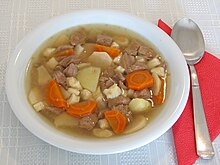 House meatsoup as házi húsleves
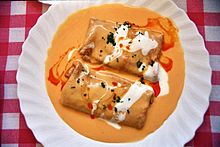 Hortobágyi palacsinta, a savoury crêpe filled with veal.

Chicken paprikash (csirkepaprikás) simmered in thick creamy paprika gravy with home made pasta called nokedli.
 Gundel Palacsinta filled with nuts and chocolate sauce.
 Stuffed cabbage (töltött káposzta) served with dill, sour cream, and sonka (ham). Töltött káposzta is frequently also served in a tomato sauce with sauerkraut and kolbász.
 Goulash (gulyásleves) in a traditional cauldron (bogrács).
Stuffed cabbage (töltött káposzta) served with dill, sour cream, and sonka (ham). Töltött káposzta is frequently also served in a tomato sauce with sauerkraut and kolbász.
 Bogrács
 Hungarian lunch starts with soup. This is veal meat soup (borjúhúsleves).
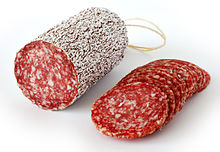 Winter salami is made from cured pork and spices, smoked slowly. During the process a special noble-mold is formed on the surface.
 Pörkölt with nokedli.
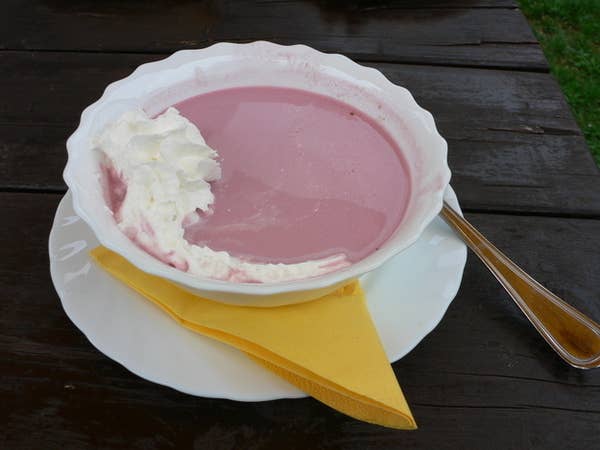
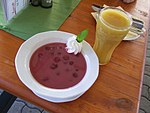 A chilled, sweet soup with redcurrants, blackberries, sour cherries, apple, pear, quince or other seasonal fruit mix.
 A popular variant on the fruit soup, which is made only with sour cherries.
 Csontleves:A basic bone broth, usually served with spaghetti noodles, carrots, and turnips. It may also be served with stewed meat (usually pork), meat bones or parsley.
 Palócleves
https://en.wikipedia.org/wiki/Hungarian_cuisine
Csaba sausage (Csabai kolbász)PaprikaHouse meatsoup as házi húslevesHortobágyi palacsinta, a savoury crêpe filled with veal.Chicken paprikash (csirkepaprikás) simmered in thick creamy paprika gravy with home made pasta called nokedli.
Gundel Palacsinta filled with nuts and chocolate sauce.Stuffed cabbage (töltött káposzta) served with dill, sour cream, and sonka (ham). Töltött káposzta is frequently also served in a tomato sauce with sauerkraut and kolbász.Goulash (gulyásleves) in a traditional cauldron (bogrács).Stuffed cabbage (töltött káposzta) served with dill, sour cream, and sonka (ham). Töltött káposzta is frequently also served in a tomato sauce with sauerkraut and kolbász.BográcsHungarian lunch starts with soup. This is veal meat soup (borjúhúsleves).Winter salami is made from cured pork and spices, smoked slowly. During the process a special noble-mold is formed on the surface.Pörkölt with nokedli.A chilled, sweet soup with redcurrants, blackberries, sour cherries, apple, pear, quince or other seasonal fruit mix.A popular variant on the fruit soup, which is made only with sour cherries.Csontleves:A basic bone broth, usually served with spaghetti noodles, carrots, and turnips. It may also be served with stewed meat (usually pork), meat bones or parsley.PalóclevesMain courses[edit]
| Name | Image | Description |
|---|---|---|
| Csirkepaprikás |  | A chicken stew with lots of sweet paprika, cream or sour cream called tejföl. Known as chicken paprikash or by some translated variant in many Central and Eastern European countries. |
| Paprikás krumpli |  | The same kind of stew as csirkepaprikás, except with potatoes in place of chicken, and usually with spicy sausage (kolbász) added as well. |
| Császármorzsa |  | Shredded, sweet crepe pieces with sugar sprinkled on top. Often served with jam (apricot or peach, usually) as well. Originates from Austria-Hungary, in Austria it is called Kaiserschmarrn. |
| Főzelék |  | A thinner, vegetable stew (almost like a soup, but thicker), similar to pottage. It can be made with a variety of vegetable bases, such as cabbage, potatoes, kidney beans, squash, spinach, lentils, tomatoes, sorrel, peas, dill, or some combination. Meatballs (fasírozott), spicy sausage (kolbász), or a fried egg (tükörtojás) may be added. It rarely appears in formal restaurants, and it usually eaten at home as a home-cooked meal. |
| Lecsó | .jpg) | A mixed vegetable stew, made of primarily tomato and paprika, also found throughout the Balkans and Central Europe. It is somewhat similar to ratatouille, but without squash and zucchini. A variety exists called tojásos lecsó (lecsó with eggs), which has scrambled eggs mixed in. |
| Székelygulyás |  | A hearty pork and sauerkraut stew, often flavored with paprika, onion, and sour cream. It is named after the Hungarian writer, József Székely (a friend and contemporary of Sándor Petőfi), who apparently asked a kocsmáros (tavernman) to mix together leftover savanyúkáposzta-főzelék (sauerkraut pottage) and sertéspörkölt (pork stew) to create it.[14] |
| Fasírozott |  | Flat, pan-fried meatballs, made from minced meat (usually pork, veal or beef) with paprika and salt added for taste. Frequently eaten with főzelék, or served with rice or french fries. |
| Stefánia szelet |  | Hungarian meatloaf with hard boiled eggs in the middle. Makes decorative white and yellow rings in the middle of the slices, and is often served with potatoes. |
| Pörkölt |  | A stew similar to ragù, made with boneless meat (veal, pork, chicken, beef, lamb), sweet paprika, and some vegetables (always onions, though). Many variations exist throughout Hungary. One famous variation (pictured) is pacalpörkölt, which is often quite spicy and made with tripe. Some others are kakaspörkölt (made with rooster), kakashere pörkölt (made with rooster testicles), and ones using pork or chicken liver (sertésmáj pörkölt and csirkemáj pörkölt, respectively). |
| Palacsinta |  | A stuffed crêpe, usually filled with jam. Other fillings that exist are sweet quark cheese (túró) with raisins, Nutella, vanilla pudding, or meat. Some more specific/elaborate variations on the palacsinta are listed in the next few rows. |
| Csúsztatott palacsinta | Layered crêpes with sweet cottage cheese, raisins, jam, and walnuts, similar to the Mille crêpe. A variation of Rakott palacsinta. | |
| Gundel palacsinta |  | Literally named Gundel crêpe. It was created by and named after Hungarian restaurateur Károly Gundel. They are stuffed with walnuts and served in chocolate sauce, and often flambéed (with rum). They traditionally also come with candied orange peels. |
| Hortobágyi palacsinta |  | A thin savory pancake, filled and covered with a meat stew, typically made from veal, onions, and spices. Often also topped with sour cream. |
| Rakott palacsinta | Layered crêpes with sweet cottage cheese, raisins, jam, and walnuts. | |
| Liptai túró |  | A spicy cheese spread with paprika, carraway, and onions. |
| Rántott sajt |  | A flat cheese croquette; cheese rolled in breadcrumbs and deep-fried. It is frequently served with french fries, mashed potatoes, rice, rizi-bizi (green peas and rice mixed together, as shown in the picture), or vegetables. |
| Rántott hús |  | Originally from Austria. Meat that is tenderized, covered in eggs, flour, and breadcrumbs, then fried. Also known as Wiener schnitzel. |
| Rántott csirke |  | A chicken breast rolled in breadcrumbs and deep-fried; similar to Wiener Schnitzel. A rarer dish, rántott galamb, is made the same way, except with pigeon. |
| Rakott krumpli |  | A potato casserole made with some combination of eggs, paprika, spicy sausage, thick bacon (szalonna), quark cheese (túró), onions, sour cream or breadcrumbs. |
| Rakott káposzta | A layered cabbage dish which consists of cabbage, pörkölt, rice, sour cream, and spices. The dish comes from the Hungarians in Transylvania (Erdélyi). | |
| Sólet |  | A Jewish-Hungarian stew made with kidney beans, barley, onions, paprika, and perhaps meat and eggs as well. It is similar to cholent. |
| Szilvásgombóc |  | Sweet plum dumplings, rolled in sweet, fried, buttered breadcumbs or streusel. May also be served with nudli, which are made from the leftover dumpling dough. |
| Túrógombóc |  | Unlike szilvásgombóc, this sweet quark cheese (túró) dumpling has no filling, and is normally served with sour cream and icing sugar. |
| Töltött káposzta |  | A cabbage roll made from pickled cabbage, filled with a light minced pork meat and rice mix. It may contain minced paprika and be served in a tomato sauce with sour cream, but this is not always the case (as in the picture). It is frequently eaten around Christmas and New Year's, but can still be eaten year-round. |
| Töltött tojás |  | Literally translates as stuffed egg or casino egg, respectively. Deviled eggs served cold (in mayonnaise) or warm (baked in the oven with sour cream), with parsley, green onions, or paprika powder added to taste. |
| Töltött paprika |  | Stuffed peppers filled with pork mince and rice mixture, served in a tomato sauce with salty boiled potatoes. Also found throughout the Balkans, where it is often known as punjena paprika. |
| Pecsenye |  | A thin pork steak served with cabbage or in the dish fatányéros (pictured), a Hungarian mixed grill on wooden platter.[15] |
| Cigánypecsenye |  | A variant on pecsenye which literally translates as Gypsy roast. Consists of fried or spit-roasted pork cutlets, with thick bacon as well, which are spiced with paprika, salt or pepper. Usually served with roasted potatoes or french fries or perhaps savanyúság (pickled vegetables) (pictured). |
| Vesepecsenye |  | Beef tenderloins, usually seasoned with paprika and salt. |
| Szűzpecsenye |  | Literally means virgin roast. pork tenderloins, which are usually prepared the same as above. May also be made into szűzérme (lit. virgin medallions; pork medallions) or szűztekercs (rouladen; thinly-cut tenderloins, stuffed with minced meat, vegetables or other things). |
| Brassói aprópecsenye | This dish is clearly named after Brassó, the former Hungarian name for Brașov, but it is unclear how, and various legends have arisen as explanation. It consists of diced pieces of pork and potatoes, which are pan-fried with onions, bacon, and seasoning (salt, pepper or paprika). This dish, despite the simple ingredients, need some practice to master. | |
| Mákos tészta | Very famous and common, an easy egg noodle dish, made with ground and sweetened poppy seeds. It has a distinct look and taste. | |
| Diós tészta | Boiled egg noodle dish served with ground walnuts and sugar, often with lekvár (jam) or honey. | |
| Gránátos kocka | A home-cooked, simple egg noodle dish, made with potatoes and paprika powder. Often served with pickled gherkins or other pickled vegetables on the side. | |
| Túrós csusza |  | An egg noodle dish, made with quark cheese (túró) and served savory (with bacon) or sweet (with sugar). |
| Vadas | Literally translates as with venison. Also known as vadas mártás (vadas sauce). Originally cooked with venison, such as wild boar, deer, wild duck or hare. But often made with beef, veal, rabbit and rarely with chicken. The meat (pre-cooked, in case of red meat) ready cooked in a brown or dark orange coloured vegetable ragout with carrots and other root vegetables. It is typically served with bread dumplings. In some cases the ragout is made separate and served on side of roast venison or beef slices. The venison version often accompanied with mushrooms. | |
| Pásztortarhonya |  | Literally translates as shepherd egg barley. A hearty dish consisting of egg barley, potatoes, onion, kolbász, and paprika, sometimes also with bacon and other vegetables. |
| Tarhonyás hús |  | Egg barley with pieces of minced meat (usually pork), but sometimes potato and kolbász as well, along with various spices. |
Sausage and cold cuts[edit]

- Hurka (boiled sausage, three main types: liver sausage called májas hurka, made of pork liver, meat and rice; a liverless variant of the májas hurka called húsos hurka and black sausage called véres hurka, which is equivalent to the black pudding)
- Téliszalámi (or Winter salami, salami made of spiced meat, cold smoked, and dry ripened, the most famous brand made by Pick Szeged)
- Herz Szalámi
- Csabai szalámi and kolbász (spicy salami and smoked sausage, made in the town of Békéscsaba)
- Gyulai kolbász (spicy sausage, made in the town of Gyula)
- Debreceni kolbász (Debrecener sausage)
- Disznósajt (pig cheese, cooked meat, for example from the pig's head, coarsely chopped, stuffed into a pig's stomach)
- Szalonna (Hungarian bacon, fatback, back bacon rind, has more fat than usual breakfast bacon)
- Virsli (a Frankfurter-like long and thin sausage, consumed boiled with bread and mustard)
- Lókolbász (Horse sausage)


沒有留言:
張貼留言